All About Vacation!

Leave a comment

I should probably start by admitting to you all that my birthday is my second favorite day of the year. My favorite day is Christmas, for the abundance of joy and warm-fuzzies that I get when it snows and everything is decked in reds, greens, and golds. But next to that, my birthday is my favorite day.

Birthdays were always celebrated with gusto in my house growing up. We got to have a birthday dinner of whatever we wanted – one year I asked my mom to make crab legs. She did, because she loves her children fiercely. Over the years my birthDAY has sort of leaked into my birthWEEK – any excuse for a young person to get drunk. Even better if the birthday falls on a Friday or Saturday – possibly a Thursday if you can swing Friday off work (or just call out, if you’re that kind of person). The festivities tend to continue until grownup life resumes, or until the liver begs and pleads for the abuse to stop.

As an adult, my birthdays varied. When I turned 19 I went clubbing with some girlfriends, which was a blast of course. 20 and 21 were the same weekend as the alumni softball tournament in my hometown – which requires an even more elaborate back story – suffice to say that my special day was lost in the alumni craziness. 22 was just a few months before getting married, and I honestly don’t remember what we did, but it clearly wasn’t that remarkable. 23 was almost immediately following the separation from my then-spouse, so I am pretty sure I celebrated in some way, but it was gloomy all the same because of the circumstances. And this year – 24 – was the most epic birthday I have ever had, except for maybe the birthday that we happened to arrive at Disney World on that day.

Anyway, so I subtly hint (read: find a way to work it into every conversation) to my boyfriend, Dave, that my birthday is coming up. He was supposed to be out of town for the summer and I had requested the weekend off to visit him, but plans changed and he is home for the summer (which rocks), but I already had the time off. I wanted to do something really fun and spectacular – less because of my birthday and more because I had four whole days off work (a lot of days if you are a server). He told me he would think of something epic.

Because I am who I am, I tried and tried to figure out what was going on. Hi, meet Kyrston, the Type A personality that feels the need to control everything. I must point out that even though that is at my core, I do an excellent job of suppressing those urges. Being a mellow and easygoing person does not come naturally to me, but I try very hard to be that way and enjoy it. So, for every ten times I wanted to ask what we were doing, I only asked once. Every time I got a vague-ish answer because he didn’t really know. Despite the inner Type A wanting to freak out, it was actually quite refreshing to just go with the flow and see what happens. So many serendipitous moments happen when we aren’t making an itemized schedule of our day.

Finally I find out we are going camping – something I haven’t done since I was a kid and my parents took care of all the details – and I start to get nervous. Sure, I know how to start a fire. With unlimited materials and a warm bed to sleep in if I lose interest. I can also pitch a tent, given enough time to mess around with the damn thing. Truth be told, I know almost nothing about camping except I know it involves weathering the elements and not being clean. Despite my nervousness, I had complete and total faith in Dave’s ability to pull this off more or less by himself. Cause, if we’re being honest, I’m probably not going to be much help.

Dave books the campsite and I immediately ask him if he checked the weather, to which he says no, which is completely Dave’s style. Honestly, what does it matter? This is what camping is all about. Besides, you can’t plan trips around the weather, especially since we all know the most accurate forecast is the one happening right this minute, and even then, sometimes it’s wrong. But of course Type A Kyrston had to check, and of course it was supposed to rain. No problem. Dave has all-weather gear for both of us. I think he might actually survive a zombie apocalypse, if we ever have one.

I was getting pretty excited… naturally all I talked about for two days leading up to Friday (the 26th) was my birthday weekend-vacation-best days of my life. Friday comes, which is my day, and I am too excited to sleep and wake up at six in the morning. That gives me about two hours to take a shower, unpack my bag and repack it (a habit I learned from my dad), and do a 12-point idiot check to make sure I have everything. As far as the rest of the details… he took care of it all. He booked the campsite, he asked me what I wanted to eat and went to every (and I mean EVERY) grocery store in town to find what we needed. He packed the car and picked me up and we were on our way!!

Let’s see… we live in southern NH and drove to Acadia National Park in Maine… about 300 miles but a six hour drive because we took US Rte 1 most of the way… it runs along the coast and is just a lovely drive. The time flew by with listening to all sorts of great music and talking about all the things we wanted to do. Dave had a complex map book thing of the state of Maine which I enjoyed looking through… maps are really cool for navigating. Even though it’s only supposed to be a six hour drive it took us closer to eight. By the time we checked in and got all the campgrounds paperwork and pamphlets of things to do, it was after 5. We arrived at our campsite and that was when I left Type A Kyrston in the car. No place for her outside my comfort zone. Time to put the brave pants on.

IMG_1843

I’m sure this all sounds very silly, but when you spend your whole life generally doing things that you feel comfortable doing, it can be scary to try new things. It was pretty easy considering I was with the camping zen master, though. We set everything up and I immediately realized that Dave is just a fantastic person. Not even to me, but just in general. He is so patient and so kind. When you’re trying to help someone who clearly has more skills, sometimes you feel like you’re just getting in the way. I didn’t want to be the girl who just sits while someone else does all the work, so I asked to help and he gave me tasks to do and I asked questions and he gave me answers. My mom told me that you can learn a lot about someone from going camping with them, and she was right. More on that later, but immediately I learned that I can go outside my comfort zone without feeling stupid or him getting exasperated at my lack of inherent camping knowledge.

We got everything set up and it was time for dinner. We had a really hard time getting a fire started. Even though Dave made the fire, I say we because he did everything exactly as I would have done it. I was not sitting watching him wanting to say a word. This is a person that has been camping more times than he can count, and not at a campground. In the real wilderness. If anyone can make a fire, Dave can. Unfortunately, despite all of the proper measures, the damn thing just wouldn’t start. We figured out that it’s because the wood we picked up on the way was not dry wood – it clearly had been split recently and had not sat for a season. Anyone who’s made a fire knows that you start with kindling and work your way up to larger pieces – but for each larger piece of wood the base fire has to be hot enough to light the other pieces. In this case, the base fire had to be hot enough to first DRY the larger pieces and then light them. Have you ever tried to make a fire with wet wood? It sucks. The best thing to do is get something very small and smoldering started and then just blow on it like an hour later and it will go up in flames, once everything has dried out. Anyway, we just decided to go out to dinner instead.

We had a lovely meal in Northeast Harbor and went back to the campsite to settle in for the night. Of course it was raining when we got back to the campsite, and I am fairly sure it rained all night. I woke up several times damp and cold in the middle of the night and did not feel particularly rested when I woke up. My morning routine generally consists of sitting quietly with multiple cups of coffee while my brain gets started. So, in the morning, Dave knew that coffee was priority one. He bought a French Press before we left, so that I could have coffee every day (is this guy sweet or what?!), and he went about getting the fire started. Again I watched him do everything right and the damn thing just wouldn’t light. Finally he got it going and we had some coffee.

As far as learning things about people, you can learn a lot about someone making a fire. It has been my experience that most young men have their testosterone and man cards tied up in their ability to make a fire. To make matters worse, they love to just throw gasoline on wood and think that’ll work. Gasoline is great for a big, hot flame – but it’s brief. The flame doesn’t get hot enough to really get the wood going, which is how a fire is maintained. Layers of heat on layers of heat. So many bonfires typically started with some idiot siphoning gasoline out of a lawn mower or something to douse it on some wood and throw a match on the damn thing. Big shock when it doesn’t work. Meanwhile, I’m sitting patiently thinking about how idiotic they all look, and after twenty minutes I make the fire myself. I don’t even have to mock them, because they know without me saying it how stupid they are. Not to mention the fact that they get all bent out of shape when their methods don’t work – as if it’s the wood that’s the problem. No, dude. User error.

Anyway, none of that happened this weekend. I sat quietly and observed Dave mess around with it for an hour, endlessly patient. He never once appeared the least bit frustrated or impatient. He just kept tending to it and trying different approaches and exerted all this careful effort to make the fire, whereas even I would have kicked a log at that point. It was so interesting to see how he reacted to the circumstances.

Once we had some coffee in us, we set out for the day. Dave was interested in hiking Cadillac Mountain, but I wasn’t really in the mood for hiking all day. The pamphlets the campground gave us talked about so many cool things to do, and we just couldn’t make up our minds. A friend of mine had told me about one particular natural feature, so it was important to me that I check it out. The access to the place was on a road that looped around the entire park – Park Loop Road, of course – so we set out to find an entrance to the park road to drive to the place I wanted to go.

On the way, we stopped at pretty much every cool place we saw. We did some moderate walking through the woods by the shore to get from one place to another, and we saw a bunch of cool stuff. We went to Sand Beach and played in the Ocean. It was hot only because the sun was shining on us, so the water was cool and refreshing. There were some pretty cool waves – some so big they came over your head – and we body surfed. Well, Dave body surfed. I either jumped into them or turned my back while they crashed against me and knocked me over. Because I didn’t wear my bathing suit, I was wearing spandex running pants and a tank top. Turns out that a lot of surf means a lot of sand in the water. Also, it means that sand gets everywhere and it’s kind of impossible to get it out just by being in the sandy water. When we finally got back to the car, I just took my pants off and put Dave’s jeans on instead. Much better.

OLYMPUS DIGITAL CAMERA

After the beach we went to Thunder Hole, which was the place my friend told me about. A lot of the Maine coastline is bedrock, it looks sort of like bluffs or cliffs. In some places the rocks aren’t very steep so you can walk around carefully along the coast. But, falling would be pretty dangerous because there really isn’t anything to stop you from falling down the rocks into the ocean. At Thunder Hole, it’s a big hole in the cliffs where the water crashed into it and sprays up and is really loud.

OLYMPUS DIGITAL CAMERA

The rocks make a gentle slope down right to the water. Because Dave is the adventurous kind, he wanted to walk down right to the water… right on the wet rocks that the surf kept crashing onto. I declined, but did take some great pictures of him walking about sixty yard to the water just as a huge wave crashed up over the rocks all over him. Then he ran back to me because he was A) soaking wet and B) almost was carried out to sea. Yikes!

OLYMPUS DIGITAL CAMERA


When we left Thunder Hole we went to Otter Cliffs. We had a nice walk up to the cliffs and along the way there was another opportunity to climb on some rocks. Dave spotted a cool spot to sit, and I again declined while he made the dangerous trek to the spot. I assumed he was walking to his death.

OLYMPUS DIGITAL CAMERA

OLYMPUS DIGITAL CAMERA

Once he returned safely, we hiked to the top of the cliffs and walked on the road back to the car. Just to give you a sense of scale, here is a picture from the top of the cliffs looking down to where he was sitting. Now I know I wasn’t being dramatic.

OLYMPUS DIGITAL CAMERA

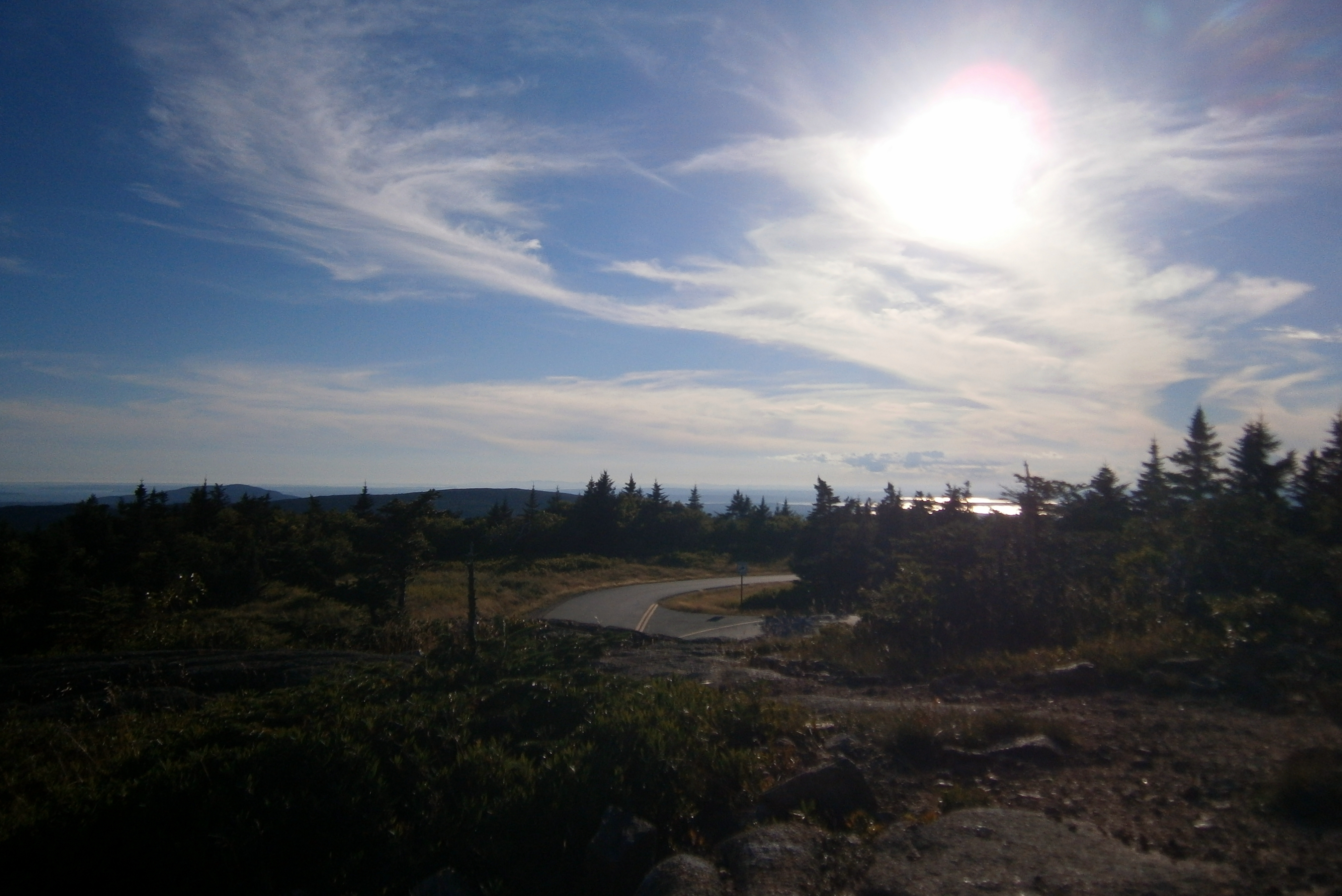
From there, we drove to Cadillac Mountain. We really wanted to reach the summit before sunset, so we were on our way. Driving to the top was cool, because we both agreed that it was nice not to spend the day hiking and got to do so many other cool things instead. When we got to the summit, we spent some time walking on the paved paths and also free-styling our walk on the bedrock around the summit and away from the people. We were trying to get to the west-facing side of the mountain to watch the sun set, without walking on the vegetation (as posted) and without going too far down so the trees obscured our view of the horizon. It was about an hour of walking to find the perfect spot. We found a cool place to sit and enjoyed the view.
OLYMPUS DIGITAL CAMERA


We went back to the campground before it got dark because I knew the wood would still be wet and it would take an hour to really get dinner going. We made steak for dinner and then crashed – we were exhausted from a day of so much activity.

Sunday we woke up and it had rained overnight. More messing around with the fuego and we finally got to breakfast around noon. We were still exhausted, and it started raining, so we took a nap until about five. I was back to being cold and wet, so I said screw it – let’s go out to dinner. At this point I was very tired and trying to figure out the best way to ask Dave if we could leave a day early and just go to Portland (we had already planned to leave Monday morning and go to Portland for the day/night, head back home Tuesday morning) because I just really needed a shower and a good night’s rest in a warm, dry place. I was getting pretty snippy as well, just tired and tired of being tired. Once I had some beef stew and a philly cheese steak (because almost every meal/snack had consisted of seafood) I felt my sense of normalcy return. Dave agreed that we should just pack up and go, considering there wasn’t much left to do and the rain would only continue.

We went to the campsite and got everything in the car just as it got too dark to really see and we set out for Portland. It took us a few hours but I was just looking forward to a bed and a shower. By the time we got to his friend’s house it was midnight, too late to shower without waking them, so I just crashed in the guest room and slept until mid-morning Monday.

Whereas my first inclination in the morning is to have a smoke and a cup of coffee, I went straight for the shower. Don’t get me wrong – swimming in the ocean and hiking around and never really having clean hands is not that big of a deal – but there’s nothing like washing your hair after three days of having it in a bun. Dave’s friends were already gone for the day, so I went to the Portland city website to see what there was to do. I came across the Portland Ice Arena, so I immediately told Dave I wanted to go ice skating. I love ice skating, absolutely love it, and haven’t been in a few years. It just so happened that the Portland Ice Arena operates year round with public skating Mondays from 11-1. We had just enough time to get out the door and go.

Even more amazing, when we arrived, there was NO ONE THERE. We were the first ones on the ice! A few people showed up shortly after, but even still, there were fewer than fifteen people there all day. It was lovely to show off my slightly impressive (read: not at all impressive) skills, which mostly consist of not falling down and some minor turns and some awkward backward skating. After an hour or so of that, we went to Old Port.

Old Port is a great place. Lots of boutiques and stuff to wander around and see. I could spend days just wandering the cobblestone streets, but food was a priority. We went to this great restaurant on the water in a three-deck boat. So elaborate and fancy – but the sign on the door said casual dress was okay. Good for us, since we were wearing jeans and flippy floppies.

After lunch, Dave’s friend was home from work so we headed back that way. We went to the park to play Frisbee (read: I chilled on the grass while they played Frisbee) and we had lots of laughs, because Dave has really funny friends. Makes sense, he’s a funny guy.

We grabbed drinks at a local pub then went back to the house to have dinner and played a game of Balderdash. If you haven’t played, I highly recommend it. It’s a game all about making stuff up and everyone trying to guess which definition of the word/person/movie is the real one. Hysterical.

The drive back was pleasant and I just knew I’d be riding my vacation birthday buzz for days. I jokingly say that I’m worried that the happy police are going to come knocking on my door and demand that I cut it out – I’m just too happy. We had such a great time!!

I did learn, also, that I should never be on the show Survivor (a lifelong dream) because I am a big whiny pants and can’t rough it for real. I’m okay with that, though, because I can sort-of rough it for brief periods of time, which is all it takes for a great vacation!


Unitarian Universalist – A Church for ALL

11 Comments

I love going to church. Unfortunately, it’s something I rarely do because I never feel like I belong. I have a spiritual belief system. It has no rules and no requirements. My relationship with God (a word chosen to represent the vague higher power) is a private one. I feel joy in sharing that relationship with others, but I am very protective of it for a variety of reasons. I choose to talk about this today in the hopes that my story can help someone else.

As a child, I was given no religious structure – meaning that I was free to choose whatever path I wanted. I am so grateful that my parents chose to parent us this way – they were available for all questions but there was never a feeling that if I believed something besides what I had been told all my life, they would be disappointed. I researched all kinds of things, went to Sunday school rarely, and for a long time considered myself an atheist. As we all know, thirteen-year-olds have it ALL figured out.

There came a point in my adolescence where I became so depressed that I was beyond the point of apathy – I was a shell of a girl. I wafted through my life, getting average grades and never getting angry and never getting sad. There was no joy and no pain, just gray. Gray everywhere inside of me. I began inflicting pain upon myself because I wanted to feel something, and a part of me knew it was wrong but it was my secret. That is, until my sister found out and told my parents and I had to go to therapy. A little bit of therapy helped a whole lot and I got much better. But, I sort of wondered how it was possible that I even survived. I know that might sound dramatic, but believe me when I tell you – I was in a dangerous place. I thought about committing suicide all the time, but I was too apathetic to even make the effort. I was truly a ghost of myself.

That was when the previously nonexistent spirituality and faith began. It started as a tiny seed, just a thought, that perhaps there was something bigger than me after all. I certainly didn’t do any of the work to get better – even the therapy was minimally effective. I don’t even remember talking to her that much, I just remember playing with magnets and that at the end she would ask me about payment, which I found to be extremely rude.

Anyway, this seed blossomed and began to grow. Today it is a beautiful tree. Probably a cherry blossom. It exists within me and is a part of who I am. I don’t even question it anymore. There have been a few times when I questioned my faith – the worst moment when my uncle died of cancer, but I even managed to work through that. I just feel a greater presence and energy all around me and I pay attention to the “signs” of the universe.

Which brings me to church. I should start by saying that I support each individual’s right to express faith in the way that he or she chooses. Religious freedom means a lot to me, and I do not see this reflected in most churches. To give you an example, when I lived in Ohio, there were many individuals in my life that were very Christian. If someone asks me, I tell them I am Christian. I have never been baptized, I have never committed myself to a church really, and I didn’t go to church every Sunday. My belief system is nothing like a Christian’s. A Christian will tell you that Jesus Christ died on the cross to save our sins, and the only way into heaven is to accept him as your savior. Until you accept Christ as your savior, you’re not allowed in heaven.

I asked one of them once – what if I am a good person my WHOLE life, I still won’t get into heaven? He said “Nope. It doesn’t work that way. You have to accept Jesus.”

Here’s what I hear: If you want to be a part of our club, you need to follow the rules. One of the rules is that you have to accept Jesus as your savior. Don’t follow the rule, you don’t get the ONE  thing that everyone talks about: heaven.

Imagine me, having gone through this entire ordeal and discovering my faith in a time of darkness, being told that my relationship with God isn’t a real relationship with God. That I’m only half a Christian, but I’ll come around. I’ll see the One True Way. Also, all those other people – the Jews, Catholics, Muslims, Protestants, Buddhists, Jehovah’s Witnesses – they are all wrong, too. But, that’s okay, because in the eyes of all of those people, the Christians are wrong. The whole thing makes my brain hurt. Who decided that one particular path to faith was the right path? Oh, that’s right, all of their Gods decided that. It kind of makes me wonder if Allah and Jesus are boxing somewhere, trying to figure out who is a more deserving deity.

Here’s what I say: seek your own individual path to spirituality, in whichever way you choose, if you want to. I’m not even saying you have to be spiritual. Do whatever you want. It’s none of my business. But, for me, walking into a Christian church I feel like an imposter! Like I’m wearing a t-shirt that says “I do NOT walk with Jesus”.

I love going to church, I love the feeling of community and the music and the prayer. I love the energy of the room when everyone is reminded to be a good person. It’s emotional and cathartic and I just adore it. But, unless I drink your club-kool-aid, I’m not really allowed.

So, that brings us to this morning. I woke up early, got all my chores done, and sat down at the computer. I poked around on the internet for a while, watched some YouTube videos, then realized it was Sunday. As I do most Sundays, I wished I could go to church, but where to go?

I decided to do a Google search to see what was around. I don’t know what any of these words mean. Episcopalian, Lutheran, etc. I thought I’d just look at the websites and see what it said under “beliefs” or “about us”. Every single website lays it out real clear: this is the way to God. Come worship with us and find out more. No, thank you. And then, just when I was starting to feel like I’d never find something, I happened upon the Keene Unitarian Universalist Church.

I had never heard of those words before. Unitarian – well that has the root word unity, which means bringing together. And then universalist, which could mean encompassing all things. I decided to take a look. The first words I read were “welcoming congregation”, but I was skeptical. They all say that and then hand you a rule book in the shape of a bible.

I went to “about us” and read the principles of faith. And then read them again. And again. Here they are:

  • The inherent worth and dignity of every person;
  • Justice, equity and compassion in human relations;
  • Acceptance of one another and encouragement to spiritual growth in our congregations;
  • A free and responsible search for truth and meaning;
  • The right of conscience and the use of the democratic process within our congregations and in society at large;
  • The goal of world community with peace, liberty, and justice for all;
  • Respect for the interdependent web of all existence of which we are a part.

The word God isn’t even on there! Holy crap! What is this about? I started to get excited! I poked around a bit more and saw the Sunday service is at 10am, and at this point it’s nearly 9.

I hopped in the shower and dashed over to my BF’s apartment to see if he wanted to go. He said sure so we walked down to the church. I was very nervous at this point, I had become so excited and I didn’t know what it was going to be like and I didn’t want to be disappointed. I have never been to a service that wasn’t about The One True Way, so I had no idea what they would even talk about!

We walked in and were greeted warmly. It was in a smallish room with fewer than fifty folding chairs. They explained that in the summertime they have much smaller services (fewer people) and so don’t use The Sanctuary (the giant room with stained glass, organs, pews, etc.) They gave us a hymn book and a piece of paper with the list of events for the day. The title of today’s sermon was This We Believe.

Apparently they did something new today – different speakers got up and talked about what they believe in. There were two men and one married couple. Oh, also, there was a giant rainbow equality flag hanging by the front. Amazing. You’d never see that in a Christian church. They don’t like homosexuality there. Something the bible says, I dunno.

So, everyone gets up and talks about where they come from. One man is a preacher’s son and had to come to terms with abandoning the family belief system. The married couple were Catholics that had just had enough of the Catholic church. The last one… well he was very hard to understand, but he quoted Douglas Adams and Hitchhiker’s – so he was okay with me. There was a small ceremony (?) where we could walk up to the front, take a pebble, tell the group whether it represented joy or sorrow and why, and drop it into a bowl of water – the ripples from the rock symbolizing the ripples of energy that accompany joy and sorrow. There was singing (I just followed along, I don’t know hymns and it’s been years since I knew how to sight-read sheet music) and stories. I couldn’t help but feel like this was exactly where I belonged. A few times I almost started crying, because I was overwhelmed with relief that I could sit in a place and express my faith with others without feeling like I didn’t belong there. There was one woman who said “blessed be” to us, which is a Wicca phrase I believe, … there were just so many elements that really erased any division between us as individuals.

My very favorite part of the entire hour was when they passed the offering basket around. I really have a problem giving money to churches, especially ones that have funding from other places. I will happily donate my hard-earned money as soon as you present an itemized report of your spending for the year. However, when they got ready to pass it around, they said “If you are visiting or brand new, please do not put money in the offering. We are just so happy that you are here with us today, that is enough.” I smiled from ear to ear!!

After it was all over, we were going to scoot out of there but of course the others were so happy to have us! It was a small group, maybe twenty people, and everyone there knew we were brand new. They wanted to know how we heard about them (because they do not evangelize, which means they do not actively try to recruit members. Of course I plugged Cheshire TV, and they jokingly made me head of communications) and what we thought. I was so overwhelmed with gratitude and happiness. It felt great to talk to them and not feel like a phony, to tell them exactly how I felt: I love going to church but I never feel like I belong because my faith is so “unorthodox”. They all smiled and nodded and seemed to know exactly how I felt.

They also loved my Beatles t-shirt – because the kind of church I want to go to is one where I can wear my Beatles t-shirt. Everyone was, not surprisingly, dressed in shorts or casual clothing. We checked out The Sanctuary, which is where normal services will resume in early September, and of course the BF walks right over to the piano to play it, but it was locked. Nevertheless, it was a wonderful morning.

So, I share this story with you all, because I know I am not the only one that struggles with wanting the church atmosphere but not feeling like staying inside the box of faith that the church requires. Or, alternatively, that respective religion. Actually, no one even said the word God the entire time I was there, except for the people telling their stories about where they come from in terms of faith. We talked about being a good person and spreading joy and happiness to our neighbors. We talked about taking care of each other and community. We talked about the things that are real and tangible for me – all things I have been saying all along, but without all the Jesus stuff attached to it.

The KUU belongs to the Unitarian Universalist Association of Congregations. If this sounds like something that you might like, you can look for a congregation here. =)

Research Paper – Final Draft (probably)

1 Comment

For all of you that have been following along, this is my final research paper on abusive relationships. It took hours upon hours (days, really) of research, pondering, emotional ups and downs, and hurdles to overcome (not the least of which is my inability to condense my thoughts – surprising, right?) but it is finally done. Considering that it’s due exactly 24 hours from now, I am mostly satisfied with the finished (ha.) product. There are so many avenues to take with this, and although I jokingly say that I will write a book, it is more likely that I will continue gathering data at a leisurely pace (I hate deadlines) and write the book when it’s ready to be written. In any case, I appreciate your feedback and support. =)

I should also note that, unfortunately, you will be missing the charming footnotes included in the paper. I do not think word press will allow me to format the post that way. But I should be able to include all of the in-text citation and the table I used, as well as my works cited and bibliography, in case you are interested in the references I used for further reading. I wish I could have read each book cover to cover, but I did not have the time nor the emotional stability to do so. Another time.


The most devastating wounds in the world are not visible. Intimate partner abuse is not only pervasive, but for too long goes unnoticed and unattended by victims and society. Most individuals define abuse as violent acts, but nonviolent abuse is more common. Nonviolent abuse is not the cultural stereotype, and a victim who experiences it may not realize it is happening or seek help. Society identifies females as the primary victims of abusive relationships, but an equal number of victims are male. This information changes the conversation about intimate partner abuse. If gender is symmetrical in terms of victim and aggressor, it is no longer about gender – it is about people. Several decades ago, intimate partner abuse became a relevant social issue and there has been a massive effort to reduce violence among intimate partners. Unfortunately, the majority of these changes have helped only half of abuse victims: women. Many male victim testimonies state that most resources available to females are not available to males. In essence, this is a two-fold problem: the full range of symptoms of abuse are not understood by victims and society, and gender, while not affecting who abuses whom, is relevant in terms of aiding the victim.

Society, and as a result, victims, have a skewed understanding of what behavior is classified as abuse. The collective misconception is that most abusive behavior is associated with violence when, in fact, there are more nonviolent abusive behaviors than violent ones. Even the dictionary has a limited definition of abuse, but definitions are based on common usage rather than science. Because nonphysical abusive incidents frequently precede violent ones, it is important to understand the full range of abusive behavior.

THE POWER AND CONTROL WHEEL

The Power and Control Wheel, created by Love is Respect, is an online resource for abuse victims. Abuse encompasses many different kinds of behavior so it can be confusing for a victim to understand what is happening. Many victims can ascertain that something is wrong in the relationship, but are sometimes unsure of how to define the treatment.

Love is Respect created The Power and Control Wheel to make it easier to understand how different behavior patterns can be classified as abuse. The Wheel separates behavior by the following categories: using social status and peer pressure; anger and emotional abuse; intimidation, threats, and sexual coercion; minimize, deny, and blame; and isolation and exclusion. The Power and Control Wheel helps a victim understand the way he or she is being treated and how it is abusive.

Note that this resource is called The Power and Control Wheel, rather than The Abusive Behavior Wheel or The Violence Wheel. “Healthy relationships are based on equality and respect while abusive ones are based on power and control” (LoveisRespect). This assertion is consistent with the conclusions of many social scientists. Abuse comes from an aggressor’s desire to control the victim, either by making the victim afraid and therefore more agreeable, or removing the victim’s feeling of freedom. One might think that aggressors are violent solely to injure victims or cause them physical pain, but in reality, aggressors abuse victims to get them to behave in a certain way. It is a form of mind-control and manipulation. There are a variety of tactics used to accomplish this and there are more nonviolent tactics than violent ones. The Power and Control Wheel is important because it raises awareness about different kinds of abusive behavior.

Because this tool is so effective in identifying abusive behavior, I used it during interviews with abuse victims. I interviewed several males and females and they shared their stories about abusive incidents from each category. For this paper, one male and one female interviewee have been selected as representative of their demographic. Note that all names and identifying information have been changed and all paraphrasing is derived from personal communication with the victim.

Peter is a 21-year-old male who grew up in New England. Peter describes his upbringing as a close, tight-knit family. He was raised in a loving, stable home and his parents have been married over twenty years. Peter has had two abusive relationships. The first relationship started when he was fifteen and lasted approximately three years. The abuse began seven months after they met and continued consistently until the relationship ended. His second abusive relationship started when he was in college and lasted three months. The abuse began about a month after they met.

Michelle is a 26-year-old female who grew up in New England. She comes from an emotionally-stable home with parents who love one another very much and are equally supportive of one another. Michelle has had three abusive relationships. The first relationship started when she was eighteen and they were together six months. Her second relationship started when she was twenty-one and their relationship lasted a year-and-a-half. Michelle’s third abusive relationship started when she was twenty-four and she was in the relationship at the time of the interview (Spring 2013).

USING SOCIAL STATUS AND PEER PRESSURE

Using social status in an abusive way includes: treating the victim like a servant, making all the decisions in a relationship, acting like the “master of the castle,” and defining gender roles in the relationship. Using peer pressure in an abusive way includes: threatening to expose weaknesses about the victim, spreading rumors and malicious lies, and revealing secrets about the victim.

Peter reports both abusive partners behaved this way. They would demand that he buy them things and would tell him that, as the man, it was his responsibility to take care of them. They did not acknowledge that he was a sensitive person with needs. They would also make decisions about where they went and what they did. Peter had one abusive partner that used peer pressure. After the breakup, she told his friends that he would hit her when angry. This was a lie meant to punish Peter and ruin his reputation.

Michelle experienced similar situations with multiple abusive partners. One partner made frequent comments about her subservience to him. Another partner complained that Michelle was not fulfilling her female role in the relationship because she did not cook, clean, or do the laundry. Multiple partners would make decisions for her by manipulating her into behaving in a way that she normally would not. Michelle had a partner threaten to tell both lies and secrets about her to her friends.

ANGER AND EMOTIONAL ABUSE

The following behavior is classified as using anger and emotional abuse: putting the victim down verbally, making the victim feel bad about him or herself, name calling, making the victim think he or she is crazy, playing mind games with the victim, humiliation, and making the victim feel guilty. These are all nonphysical types of IPV using words to wound the victim’s self-esteem and sense of self-worth. The lower a victim’s self-esteem and sense of self-worth, the more willing he or she is to allow the abusive behavior.

Peter listed multiple abusive partners that used anger and emotional abuse. Both partners put him down repeatedly. They called him useless and that he was going nowhere in his life. They called him derogatory names, especially when Peter tried to express concern about the abuse or relationship. The aggressors also tried to make him think the abuse was his fault by claiming that he provoked them in some way. This tactic was extremely effective. The behavior was so outrageous that Peter was convinced something was wrong with him to cause women to treat him this way. Sometimes they denied that the abuse was happening at all, or refused to have a conversation about it. One partner would play mind games with Peter, cheating on him and then when he forgave her, she would tell him that he obviously didn’t love her if he wasn’t angry. Peter also didn’t love her if he didn’t behave the way she wanted him to.

Michelle also had abusive partners that used anger and emotional abuse. Some partners told her she was fat and lazy while others told her that her friends didn’t like her. She has been called every profanity; some partners even addressed her with a curse word instead of her first name. Some also played mind games, having what Michelle referred to as a “violent fit of rage” and then a few minutes later start crying and go into a state of depression, asking for her to help. Some also humiliated Michelle, one in particular by refusing to acknowledge that they were in a relationship. Some also made her feel guilty for either not taking care of them properly or because the breakup caused additional problems in the aggressors’ lives. Some also made Michelle think she was crazy or that she had made them abuse her.

INTIMIDATION, THREATS, AND SEXUAL COERCION

Intimidation is used by making the victim afraid by looks and gestures, smashing things, destroying property, abusing pets, and displaying weapons. Threats are used by threatening the victim with violence, threatening to leave or commit suicide if the victim does not behave in a certain way, making the victim drop charges, or making the victim do illegal things. Sexual coercion is used to manipulate the victim or making threats to have sex, threatening to take the victim’s children away, getting the victim drunk or drugging the victim for sex, and repeatedly making sexual advances after the victim has said no. This category contains more commonly recognized signs of abuse, including physical violence. The Power and Control Wheel does not have a separate category for physical violence, but violent behavior typically falls under this category.

Peter had many abusive incidents with multiple partners on varying levels. One partner threatened to commit suicide if he left her and he stayed with her because he did not want that on his conscious. Another partner threw things when she was angry, punched windows and walls, punched him, threatened to drive her car off the road while he was in the vehicle, and punched mirrors. If Peter did not want to have sex, his partners got angry and stomped out of the room or ignored him. His partners also made him steal for them. As previously mentioned, Peter’s aggressors defined his gender role in the relationship as the provider. If Peter could not afford to purchase something, the partners demanded that he steal it for them. Peter did this because they did not present it as an option.

Michelle had partners who used these tactics as well. She has been choked while being pinned against a wall, shoved so hard she flew across the room, champagne dumped on her head, kicked in the lower back, hit with a bat, and pushed onto a floor of broken glass. One partner broke her bedroom door trying to break into her bedroom when she fled. Her phone has been thrown in a toilet, and one partner even tried to push her friend down a flight of stairs. Michelle stated that her abusive partners were very careful not to injure her to the point where she would need to seek medical attention, although one partner did break her finger by slamming it in a door. The partners also insisted that Michelle do illegal things for them, such as driving drunk to get more alcohol for the aggressor, or driving the aggressor to buy illegal drugs.

MINIMIZE, DENY, AND BLAME

When an aggressor uses minimization, denial, and blame against a victim, he or she is reinforcing that the victim has no value or credibility. This is a very effective tool used to manipulate victims into behaving in a certain way. The behaviors include making light of the abuse and not taking it seriously, denying that the abuse ever happened, shifting responsibility for the abuse to the victim, and telling the victim that he or she caused the abuse.

Peter’s abusive partners handled addressing the abuse in different ways. Some partners pretended nothing happened and others told him he was being ridiculous. Sometimes his partners brought up something that Peter did a long time ago to change the topic of conversation, or told him that it was his fault.

Michelle had partners who told her the abuse was her fault. Other partners claimed that she was being dramatic and told her she got upset over everything. Others claimed to not remember the abuse happening.

ISOLATION AND EXCLUSION

Isolation and exclusion are types of abusive behavior aimed at limiting the victim’s contact with the outside world. The aggressor may try to control with whom the victim spends time or where he or she goes. The aggressor frequently uses jealousy as the reason for behaving this way.

Peter had one partner that would use isolation and exclusion in an abusive way. She would tell him who he could and could not hang out with, told him what music to listen to, and what to wear. Peter described her as very possessive and controlling.

Michelle had multiple partners treat her this way. One would text and call her up to one hundred times a day when she wasn’t with him, and another would make her feel like she could never leave his side because he needed her so much.

AFTERMATH

The multiple tactics an aggressor will use to control and hurt a victim are frighteningly effective. Both Peter and Michelle experienced this treatment across multiple partners and over an extended period of time – these were not isolated incidents. Typically, abuse starts with the least-severe types of nonphysical abuse and becomes increasingly severe over time. In many cases, victims are either not aware that this behavior is abuse or are unsure how to address it. Even after the victim realizes what is happening, it is common that he or she will stay in the relationship. The reasons for this vary, but every victim deserves respect and kindness. Society will commonly judge a victim harshly for staying in an abusive relationship, but it is hard to understand the mental and emotional trap that exists within one. For both Peter and Michelle, they did not want to fail. They both believed they could fix the relationship if they tried hard enough. Other individuals may be too financially unstable to separate from the partner, there may be children involved, or friends and relatives may pressure the victim to fix the broken relationship. Often victims stay because they do not believe they deserve better treatment, or they feel an obligation to support and take care of the aggressor. They may feel what is happening is wrong, but their self-esteem and self-worth are low and they are hesitant to make a change. In any case, it is complicated and difficult to extract oneself from an abusive circumstance.

Although many of the abusive incidents that Peter and Michelle experienced lefts visible signs of abuse, there are far more emotional wounds – the most devastating wounds in the world are not visible. Peter, for example, drank heavily after the abusive incidents and was depressed for a long time. At one point, he considered committing suicide, even putting a belt around his neck in preparation and stopping at the last minute. Even though these events happened several years ago, Peter described himself as jaded and has episodes of depression. His aggressors’ tactics changed the way he feels about himself and relationships.

ABUSE AND SOCIETY

The Power and Control Wheel is comprehensive, but not all-inclusive. Because some abusive behaviors are more severe than others, society generally defines abuse as violent acts. The behaviors described in the preceding paragraphs might seem common, and that is because most relationships contain one or more of these behaviors from not just one, but both partners. To further complicate things, pop-culture defines our gender roles and we subconsciously play our parts. Men and women are defined in specific ways – often with the woman being represented as emotional, needy, and overbearing. The man is often represented as unfeeling, masculine, and invulnerable. These representations have affected the way human beings see one another. Aggressors know this, whether it be consciously or subconsciously, and can easily take advantage of preconceived notions to play into the stereotypes.

For example, a man can treat a woman as overly emotional, dramatic, needy, and weak. The woman is more likely to accept this treatment because society and pop-culture have trained her to believe these things about herself. Decades ago, intimate partner abuse became a widely accepted cultural phenomenon and there has been much progress to combat the “War on Women”. There are many websites, organizations, and resources for abuse victims. Unfortunately, most of these resources are catered towards women, with some even stating that the most common victims of abuse are women, even though nearly every scientific study conducted shows that there are an equal number of male and female victims and aggressors (Fiebert).

Table 1

Study Source Severity Male Female
Canadian National Survey Lupri, 1990 Severe
Minor
17.8%

10.01%

23.3%

12.9%

Canadian General Social Survey 1999 Overall Rate 7.0% 8.0%
British Crime Survey 1996 Overall Rate 4.2% 4.1%
National Comorbidity Study Kessler, 2001 Minor

Severe

17.4%

6.5%

17.7%

6.2%

National Alcohol and Family Violence Survey Straus, 1995 Overall Rate

Severe

9.1%

1.9%

9.5%

4.5%

Dunedin Health and Development Study US Dept of Justice, 1999 Overall Rate 27.0% 34.0%
National Violence Against Women Survey Tjaden & Thoennes, 2000 Overall Rate 1.3% 0.9%
Youth Risk Behavior Survey Center for Disease Control, 2006 Overall Rate 8.8% 8.9%
National Youth Survey Wofford-Mihalic, Elliott, & Minard, 1994 Overall

Severe

20.2%

5.7%

34.1%

3.8%

Percent of Emergency Room Visits for PV [partner violence] Ernst et al., Annuals of Emergency Medicine, 1997 19.0% 20.0%

Note: From Murray Straus, Ph.D., Co-Director Family Research Laboratory, University of New Hampshire, presentation to the National Family Violence Legislative Center conference “From Ideology to Inclusion,” Sacramento, California, February 2008. Courtesy of Murray A. Straus. (Cook, p 13)

This table, located in Philip W. Cook’s book Abused Men: The Hidden Side of Domestic Violence (courtesy of Dr. Murray Straus), reveals the truth about male and female perpetrators. There are ten examples from the hundreds of studies that have been conducted by social scientists. The last two columns – male and female – identify the aggressor of the violence in the relationship. Statistically speaking, there are an equal number of male and female aggressors. This information is crucial in how society handles intimate partner abuse. One of the first studies conducted was in the 1970’s by Dr. Murray Straus, a highly-respected social scientist in the field of partner violence. The study reflects the same results: there is gender symmetry in the aggressors of intimate partner abuse. A second study conducted by Dr. Straus, ten years later, reflects the same information. By 1986 there were twenty-three surveys, including two national ones, which reflected the insignificance and symmetry of an aggressor’s gender. This information is alarming, because after almost forty years of research and data, there are still men – including Peter – that say they are indeed the victim and not the aggressor. The results have not changed the way society views intimate partner abuse.

Society’s interpretation of gender roles affects the way intimate partner abuse is handled when it comes to the support of the victim. It is well-known that female victims have a plethora of support and resources in a time of crisis. Law enforcement officers are better equipped to handle what was, at one time, seen as a private family matter. It is easier to obtain and enforce a restraining order. There are crisis hotlines, shelters, and support groups. All of these resources and tools are wonderful for a traumatized victim. It is hard to leave an abusive relationship – the more help the victim has, the better chances of success. Sadly, only half of the victims in question have access to this support: females.

Male victims have little-to-no support by comparison. With society assuming men to be the aggressor and not the victim, the resources available to women are not available to men. Male victims also struggle with how to feel about the abuse received from a female. Many men are bewildered, confused, embarrassed, and ashamed. These emotions exist in female victims, but are exaggerated in males due to the pressure of society’s expectations and preconceived notions about gender roles. Peter had a similar problem – he did not tell anyone about the abuse while it was happening, and seldom talked about it afterward. When a male victim finally does speak out and tries to seek support to make the abuse stop, they encounter many roadblocks. Many male victim testimonies reinforce this fact, as seen in the following victim interviews conducted by author Philip W. Cook:


My attorney was no use. She was slow to act and never requested a restraining order. (p 68)

I had read in M.S. magazine that if you are the victim of domestic assault, you should get treatment, take photographs, which I had a friend do, and call a domestic violence shelter. So I spent several hours that evening calling, saying, ‘This is what happened. The police refuse to take a report. I need a restraining order. How can I get her arrested?’ They [the domestic violence shelter] said, ‘Well, we don’t help know what to say to a man.’ Or, ‘We just help women.’ They would refuse to answer my questions because I am male. (p 69)

If it had been a man beating up a woman, they would have made an arrest. They [the police] said, ‘We ain’t taking no report from you buddy.’ (p 68)

The judge asked me about my career plans. I told him that I was working on building up a consulting practice in my home (which I had experience in), using the computer, fax, and modem, so I could be at home most of the time to take care of the kids. The judge (who is in his seventies), looks at me and says ‘Young man, you need to go out and get a regular job, and fulfill a more traditional father role.’ [Later in the interview, the interviewee tells Cook that full custody of the children was awarded to the ex-wife, despite overwhelming evidence of abusing the interviewee.] (p 72)


The problems associated with intimate partner abuse are numerous and overwhelming. Explored in this research paper are abusive behaviors and the role of male victims in relation to society’s perception of gender roles. The victim is often confused as to which behaviors can be classified as abusive. The Power and Control Wheel is as informative as it is valuable in assisting the victim to feel validated. Society’s understanding of aggressor gender roles is inaccurate and negatively affects the support and resources available to only half of all abuse victims. These two issues only represent a small portion of problems. Others include the victim’s long-term psychological complications as a result of intimate partner violence (including posttraumatic stress disorder), ineffective prevention methods, and limited awareness. The limited awareness raises the most questions. Why is it that, after forty years of research and over two hundred studies, the collective view on intimate partner abuse is so inaccurate and unchanging? Specifically, how it is not common-knowledge that an equal number of victims are male, rather than the stereotype that most victims are female? If this misconception exists for intimate partner abuse, it is likely that it also applies to other relationships as well. This type of treatment extends beyond intimate relationships to relationships with friends, family, coworkers, and strangers. If we, collectively, understand the full spectrum of abuse – and the variety of ways that we can hurt one another – perhaps we can end the cycle and exist in a more respectful community.


WORKS CITED

“abuse.” Dictionary.com Unabridged. Random House, Inc. Web. 16 Jul. 2013.

Cook, Philip W. Abused Men: The Hidden Side of Domestic Violence. Westport, CT: Praeger, 1997. Print.

Fiebert, Martin S. “References Examining Assaults By Women On Their Spouses Or Male Partners: An Annotated Bibliography.” References Examining Assaults by Women on Their Spouses or Male Partners: An Annotated Bibliography. Department of Psychology, June 2012. Web. 18 July 2013.

BIBLIOGRAPHY

Felson, Richard B. Violence & Gender Reexamined. Washington, DC: American Psychological Association, 2002. Print.

Jasinski, Jana L., and Linda M. Williams. Partner Violence: A Comprehensive Review of 20 Years of Research. Thousand Oaks, CA: Sage Publications, 1998. Print.

“Loveisrespect.org.” Web. N.p., n.d. Web. 16 July 2013.

O’Leary, K. Daniel, and Erica M. Woodin. Psychological and Physical Aggression in Couples: Causes and Interventions. Washington, DC: American Psychological Association, 2009. Print.

Research Paper – Assertions and Thoughts

5 Comments

The first draft of my research paper is due on Monday, and I have a lot of thoughts floating around in my head. I’ve been pretty busy lately, and haven’t made the time to write, but I decided to sit down and get my thoughts out so that I may see some semblance of order. I am really excited to share my findings with the world – this is heading in a much different direction than I anticipated.

Coming from an abusive relationship, I thought for sure that I would want to write all about the war on women. I mean, what could be greater than reaching out to all the poor, defenseless, women that have been mistreated by their partners? I was on this path to further educate the world about abusive relationships and warning signs.

If you have been following along throughout this process, you know that I recently conducted several interviews with abuse victims about the kinds of abuse they received. Approximately half were male and half were female. I must say that the male stories had an unexpected effect on me. I was horrified. The effort to raise awareness on abuse towards women has been going on for over thirty years – and some studies indicate that although it is still a major social issue, it’s trending down. Obviously it is my deepest hope that no woman ever receives abuse ever again. However, it is obvious that women do have a voice and an advocate, from community resources to literature to the behavior of the police to the behavior in the courtroom. Women have an entire army to back them.

But what about the men?

I will tell you that there have been near three hundred surveys done regarding domestic violence, intimate partner violence, and abuse in relationships. These are not your typical surveys. They are conducted by highly respected scholars. PhDs, MDs, graduate students, scientists… and they are thorough and extremely scientific. I can hardly read the description of how the survey was conducted… most of the words make no sense to me. Words like multi-collinearity, logistic regression analysis, and all kinds of talk about variables, coefficients, and controls. Basically, it is obvious that this wasn’t some online survey conducted by a questionable magazine. This represents real research. I read every word and tried to make sense of what they were telling me. It wasn’t hard to understand… as long as I didn’t try to figure out what logistic regression analysis meant. I’ll just trust that if they know the word, they must be respectable. Plus, all of the studies are published in peer-reviewed journals.

Anyway, that’s off topic. I am only telling you this so that you know that these findings are, in fact, scientific. I won’t cite all my sources now, because I am making broad statements, but you will see in my final research paper (when I post it) the citations and you can look it up for yourself.

Before I tell you what I’ve found, a few words on how to write a research paper. Apparently I have been doing it wrong my entire life. Most people, when they want to write a research paper, will think of a thesis and then search for evidence to support that thesis. This is backwards. It’s called a RESEARCH paper for a reason: first you do the research, then you make assertions, then you form your thesis. An assertion is basically a factual statement derived from the evidence found in research. So, that being said, here are my assertions for my paper (read: factual statements based on the support of evidence):

Assertion One: Abuse is equal between men and women. And when I say equal, I mean nearly 50-50. It is not going to be a perfect divide, of course, and sometimes it’s more men than women and more women than men. But the point is this – for every woman who is abused, there is one man who is abused. The ratio is 1:1. Even more alarming, this statistic applies to the aggressor as well. That’s right: for every one man who abuses a woman, there is one woman who abuses a man. Mind. Blown.

Assertion Two: Women are more likely to be violent because they know men won’t retaliate. This might be a tough pill to swallow. It casts my gender in a negative light, and a truly horrific and terrifying one at that. Doesn’t that mean that abusive women take advantage of the fact that men are raised not to hit back? Yes. But, wait a minute, haven’t we been saying that men take advantage of women for smaller stature all these years? Hasn’t it been ingrained in us that we are the weaker gender and that bad men will exploit that? Well, apparently, bad women will exploit a man’s weaknesses, too.

Assertion Three: Male victims are given less help by the police force, the courtroom, and community resources. This shocked me and made me feel pretty nauseous. There are so many variables at play here – but the chief one is that our societal view of what a man “should” be affects our judgement. Victim interviews state that when a wife attacked a husband (successfully, of course, because good men don’t strike women) and he called the police, they refused to arrest her. Another instance is that a judge would not approve a restraining order for an abusive wife, and she somehow obtained custody of their children and he was left with nothing. Another example is that one man called a battered women’s shelter, just needing advice on who to turn to, and they told him that they only help women and hung up the phone. It’s no wonder that men can’t talk about it when it’s happening – and to know that they receive little to no support? I think about what I went through and wonder… if other people had treated me like it was meaningless, if I had no support, if the police had just left that night… what would have happened? I can tell you what would have happened… I would not have been able to heal without the support and validation of my friends and family. And if I had been made to feel like it was no big deal… it would have crushed me, and it would not have gotten better. I say, with no dramatics whatsoever, that I probably would have committed suicide. Think about that. How strong do I feel when I have an army backing me – versus how strong is a man, who is really just a person, dealing with the same emotions, with no support?

Assertion Four: Abuse causes severe psychological damage. This is brief and true. Most of my interview subjects have been through bouts of depression, some hurting themselves while others seriously considering committing suicide. It’s post traumatic stress disorder, and it’s nothing to play around with. Sure, this might all sound dramatic, but as we saw with Peter – when a kid has a belt around his neck considering taking his own life, and credits the woman who made him feel like he was less than worthless, abuse is a serious problem. And, even if that happened years ago, he’s still not okay. None of us are ever going to be okay. That dark place… it’s always going to be there.

There are more assertions pending, and my teacher playfully reminded me that this is a ten page paper, under twenty pages please. I cheerfully informed him that he will be receiving a single-spaced twenty page paper. Ha-ha. There’s just so many aspects of this that are so important. First of all – what is abuse, anyway? Defining my terms and listing abusive behaviors… and encouraging the reader to really think about what it means to treat others with respect. I have done some of those things on that list, and I knew they were bad when I did them. Sometimes we act out when angry, sometimes we just can’t help ourselves. Sometimes this and sometimes that – the whys don’t matter as much as admitting that we abuse one another on a frequently basis. Our family, our friends, our coworkers… with varying levels of severity of course, but this is an abusive world. When you really start to think about how people treat one another, suddenly it’s all you see. Me, personally… I’m never going to go to that place again. I’m never going to disrespect others if I can help it, and I will not allow others to disrespect me.

So, as this process unfolds, I find myself more and more an advocate for men rather than an advocate for women. As I stated earlier, women have an army to back them. They are pitied by the public, protected by the police, and the court sees them as the inherently downtrodden gender. Every piece of the puzzle is engineered to help empower women and help them to get out of a dangerous and unhealthy circumstance. But, the men are not only receiving an equal amount of abuse, they have little to no resources. On top of that, it seems that there are barriers put in place to prevent them from achieving the same goal: get away from the abuse.

So, with that being said, I declare myself an advocate for male survivors. I will contact the MCVP and see what resources they have for male victims. I will start support groups, start the conversation in our society, and spread awareness. It seems so silly, almost insulting, to be a woman advocate for males. But why do I think that? Only because the way we view men, as a society, is so deeply ingrained that I think this: won’t it be weird to be a woman (lesser gender) fighting for male victim rights? Doesn’t that make the male look weak if he needs a woman to come to his aid? Who says? Who?! How about this instead: people abuse people. People that are female have resources and support to extricate themselves from abusive relationships. People who are men do not have that luxury. The system is horribly imbalanced and something needs to be done. Who cares who helps? Male, female, lesbian, gay, transgender, or Klingon – it’s all hands on deck, people.

Be a part of it.